
 +91-9210-914-391
 WhatsApp

 Book Appointment
What Are the Types of Refractive Errors? A Complete Guide to Myopia, Hyperopia, Astigmatism & Presbyopia
Refractive errors are the most common reason people need glasses, contact lenses, or vision correction surgery — yet many people don't know exactly which type they have or why it happens. This guide breaks down all 4 types of refractive errors in plain language, along with symptoms, causes, and the treatment options available at Save Sight Centre, Delhi.
🔎 Quick Answer: The 4 Types of Refractive Errors
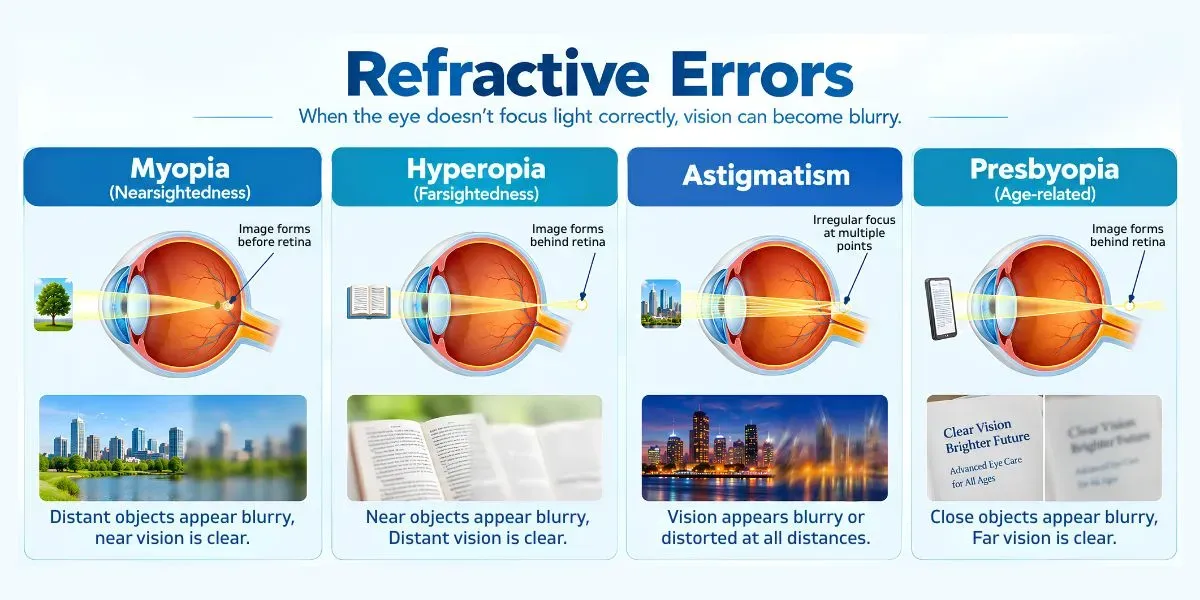
A refractive error is a vision problem that happens when the shape of your eye or cornea prevents light from focusing correctly on the retina, causing blurred vision. There are 4 main types: Myopia (Nearsightedness) — distant objects look blurry; happens when the eyeball is too long, or the cornea too curved. Hyperopia (Farsightedness) — close objects look blurry; happens when the eyeball is too short. Astigmatism — objects at any distance look blurry or distorted, due to an irregularly shaped cornea or lens. Presbyopia — age-related loss of near focus, usually starting after 40, as the eye's natural lens becomes less flexible. At Save Sight Centre, a NABH and ISO accredited hospital opposite Adarsh Nagar Metro Station, our team — Dr. Rajeev Jain, Dr. Shuchi Gupta, and Dr. Ankit Malhotra — diagnoses your exact type and power through a comprehensive refraction test, and offers correction through glasses, contact lenses, or permanent vision correction surgery like LASIK.
What Do You Need to Know About Refractive Errors?
There are exactly 4 types of refractive errors: myopia, hyperopia, astigmatism, and presbyopia — and you can have more than one at the same time.
Refractive errors affect an estimated 1.5 billion people worldwide, making them the most common eye condition globally.
Myopia typically starts between ages 6–14; presbyopia affects nearly everyone after age 45 — refractive errors can appear at any life stage.
A simple refraction test can precisely diagnose which type(s) you have and your exact power.
Correction options range from glasses and contact lenses to permanent surgical solutions like LASIK, ICL, or RLE.
Uncorrected refractive errors in children can lead to amblyopia (lazy eye) if not treated early.
What Is a Refractive Error and Why Does It Happen?
A refractive error is a problem with how your eye focuses light. For you to see clearly, light entering your eye must bend (refract) precisely enough to land exactly on your retina — the light-sensitive layer at the back of your eye. When the shape of your eyeball, cornea, or lens doesn't allow this to happen correctly, the image is out of focus, and vision becomes blurry.
Refractive errors happen for a few key structural reasons: the eyeball being too long or too short from front to back, an irregularly curved cornea, or — in the case of presbyopia — the natural lens inside the eye becoming stiffer and less able to change focus as you age. Genetics, environmental factors like limited outdoor time in childhood, and the natural aging process all play a role in who develops which type.
It's worth understanding that a refractive error is not an eye disease — your eye is healthy, it's simply shaped in a way that doesn't focus light perfectly. This is exactly why refractive errors are so effectively correctable with glasses, contact lenses, or surgery.
What Are the Symptoms of a Refractive Error?
Symptoms can vary depending on which type of refractive error you have, but several signs are common across all of them:
⚠ Watch for these warning signs:
- Blurred vision at near, far, or both distances
- Double vision in one or both eyes
- Headaches, especially after reading, screen use, or driving
- Eye Strain & Fatigue — Eye strain or fatigue during close-up work
- Squinting to try to see more clearly
- Difficulty seeing at night or in low light, especially with glare around lights
- Light Sensitivity — Sensitivity to bright light
✓ Risk Factors for Refractive Errors
- Eyeball Length — An eyeball that's too long causes myopia; one that's too short causes hyperopia. This is the single biggest structural factor behind most refractive errors.
- Cornea or Lens Shape — An irregularly curved cornea or lens causes astigmatism, bending light unevenly instead of focusing it to a single sharp point on the retina.
- Aging of the Lens — The natural lens inside the eye gradually stiffens with age, losing its ability to change shape and focus on close objects — this is what causes presbyopia.
- Genetics — Refractive errors, especially myopia and astigmatism, often run in families — if your parents wear glasses, your own risk is meaningfully higher.
- Screen Time & Near Work — Extended close-up work, including screens and reading, is linked to myopia progression, especially in children, while limited outdoor time appears to increase risk.
- Environmental Factors — Time spent outdoors during childhood is associated with lower rates of myopia, though the exact biological reason isn't fully understood.
What Are the 4 Types of Refractive Errors?
Every refractive error falls into one of these four categories, though it's common to have more than one at the same time (for example, myopia with astigmatism):
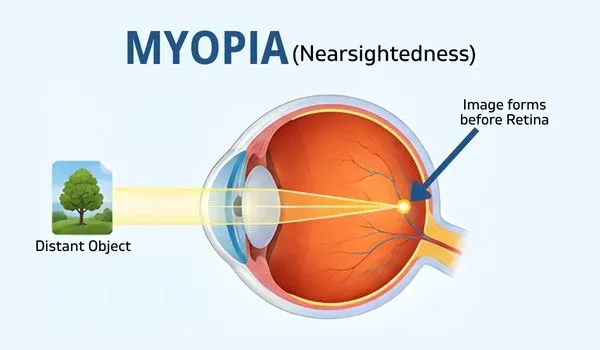
Myopia (Nearsightedness)
Distant objects look blurry while close-up objects stay clear. Happens when the eyeball is too long, or the cornea too curved, so light focuses in front of the retina instead of on it. Usually starts between ages 6–14.
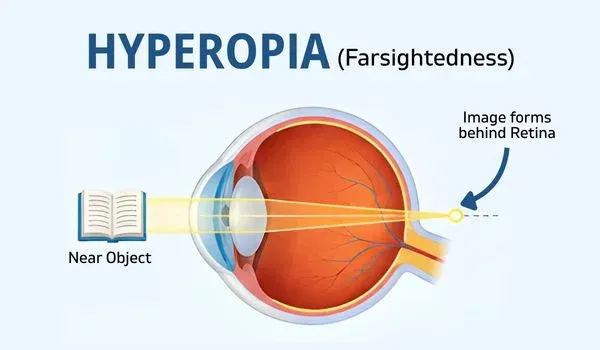
Hyperopia (Farsightedness)
Close-up objects look blurry, while distant vision may stay clearer, especially in mild cases. Happens when the eyeball is too short, so light focuses behind the retina. Most people are born with it.
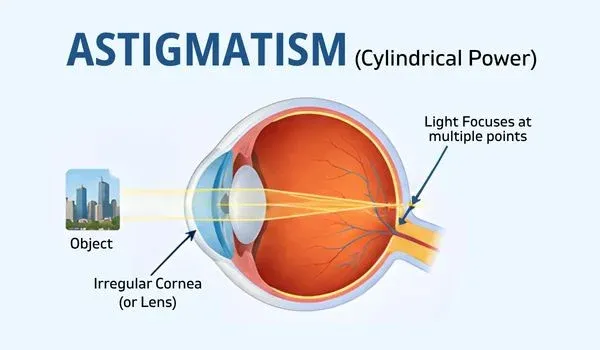
Astigmatism
Objects at any distance can look blurry, stretched, or distorted. Happens when the cornea or lens has an irregular, non-spherical shape, bending light unevenly. Often occurs alongside myopia or hyperopia.
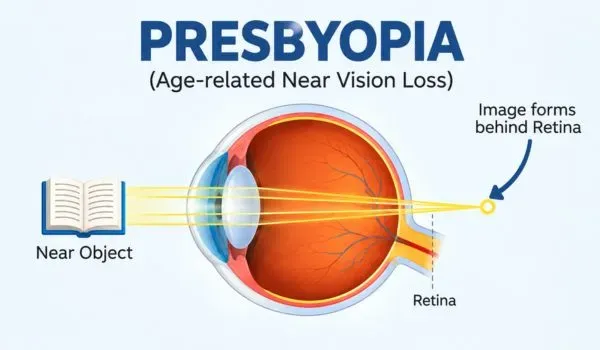
Presbyopia
Difficulty focusing on close objects, typically starting after age 45, as the eye's natural lens gradually loses flexibility with age. Nearly everyone develops presbyopia eventually.
What Causes Refractive Errors?
Refractive errors develop due to a combination of structural, genetic, and environmental factors:
Eyeball Length
An eyeball that's too long causes myopia; one that's too short causes hyperopia. This is the single biggest structural factor behind most refractive errors.
Cornea or Lens Shape
An irregularly curved cornea or lens causes astigmatism, bending light unevenly instead of focusing it to a single sharp point on the retina.
Aging of the Lens
The natural lens inside the eye gradually stiffens with age, losing its ability to change shape and focus on close objects — this is what causes presbyopia.
Genetics
Refractive errors, especially myopia and astigmatism, often run in families — if your parents wear glasses, your own risk is meaningfully higher.
Screen Time & Near Work
Extended close-up work, including screens and reading, is linked to myopia progression, especially in children, while limited outdoor time appears to increase risk.
Environmental Factors
Time spent outdoors during childhood is associated with lower rates of myopia, though the exact biological reason isn't fully understood.
What Tests Are Used to Diagnose Refractive Errors?
Diagnosing a refractive error precisely — including exactly which type(s) and how much correction you need — involves a few key tests:
Visual Acuity Test
The familiar eye chart test measures how clearly you can see at a standard distance, giving a baseline read on your current vision.
Refraction Test
Using a phoropter with different lens combinations, your doctor precisely measures your exact prescription for each eye, identifying myopia, hyperopia, and astigmatism together.
Retinoscopy
An objective test where light is shone into the eye to estimate refractive error without needing you to respond — especially useful for young children.
Autorefractor Measurement
A computerised instrument that quickly provides an initial, objective estimate of your refractive error, which is then fine-tuned with a manual refraction.
Corneal Topography
Maps the surface curvature of your cornea in detail, particularly useful for accurately diagnosing and quantifying astigmatism.
Slit-Lamp Examination
A detailed microscopic exam of the front of the eye, ruling out other eye conditions that could be contributing to blurred vision.
How Are Refractive Errors Corrected?
Every type of refractive error is correctable. The right option for you depends on your lifestyle, how much correction you need, and whether you want a permanent solution.
Non-Surgical Correction — Glasses and contact lenses remain the most common way to correct refractive errors, offering flexibility without any procedure.
Eyeglasses
Prescription lenses correct myopia, hyperopia, and astigmatism with single-vision lenses, or presbyopia with bifocal or progressive lenses. The simplest, most adjustable option.
Contact Lenses
Thin, curved lenses worn directly on the eye correct the same refractive errors as glasses, often preferred for sports, convenience, or appearance.
Regular Monitoring
Since refractive errors can change over time — especially in children and after age 40 — periodic eye exams ensure your prescription always matches your current vision.
Surgical Correction — For those who want to reduce or eliminate dependence on glasses and contacts permanently, several proven surgical options are available.
LASIK
A laser reshapes the cornea to correct myopia, hyperopia, and astigmatism permanently. The most common refractive surgery, with several technology options available.
ICL / IPCL
A permanent lens is implanted inside the eye without removing corneal tissue, ideal for higher refractive errors or thinner corneas not suited to LASIK.
Refractive Lens Exchange (RLE)
The eye's natural lens is replaced with an artificial IOL, often chosen by patients over 40 who also want to address presbyopia at the same time.
What Can You Do to Protect Your Eyes from Refractive Errors Progressing?
Spend Time Outdoors
Especially important for children — outdoor time is linked to a lower risk of developing or worsening myopia.
Follow the 20-20-20 Rule
Every 20 minutes of near work, look at something 20 feet away for 20 seconds to reduce eye strain.
Use Proper Lighting
Read and work in adequate light to reduce unnecessary strain on your eyes during near tasks.
Wear Your Correct Prescription
Using an outdated or incorrect glasses/contact prescription can worsen eye strain and headaches.
Get Regular Eye Exams
Refractive errors can change gradually — periodic testing catches these changes before they affect daily life.
Myopia vs Hyperopia vs Astigmatism vs Presbyopia: What's the Difference?
Here's a side-by-side comparison of all 4 types of refractive errors to help you understand exactly how they differ:
| Basis | Myopia | Hyperopia | Astigmatism | Presbyopia |
|---|---|---|---|---|
| Vision Affected | Distance blurry | Near blurry | Blurry/distorted at any distance | Near blurry (age-related) |
| Eye Structure Cause | Eyeball too long | Eyeball too short | Irregular cornea/lens shape | Lens loses flexibility |
| Typical Onset Age | 6–14 years | Often present from birth | Any age, often from birth | After 40–45 years |
| Can Occur With Others? | Yes, often with astigmatism | Yes, often with astigmatism | Yes, with myopia or hyperopia | Yes, adds to any existing error |
Vision Affected
Eye Structure Cause
Typical Onset Age
Can Occur With Others?
What Happens If a Refractive Error Is Left Uncorrected?
Refractive errors are highly correctable, but leaving them unaddressed — especially in children — can have real consequences:
Chronic Headaches & Eye Strain
The eyes constantly work harder to try to focus, leading to frequent headaches, fatigue, and discomfort, especially during reading or screen use.
Reduced Academic & Work Performance
Blurry vision makes reading, driving, and screen work harder, affecting concentration and performance at school or work.
Amblyopia (Lazy Eye)
In children, uncorrected refractive errors — especially uneven ones between the two eyes — can lead to permanently reduced vision in one eye if not treated early.
Increased Risk with High Myopia
Severe, uncorrected myopia (high myopia) is associated with an increased risk of other eye conditions, including retinal detachment, later in life.
How Much Does Refractive Error Correction Cost in Delhi?
Cost depends entirely on which correction option you choose — from an affordable pair of glasses to permanent surgical correction:
| Correction Option | Cost |
|---|---|
| Comprehensive Refraction Test | Consultation charges apply |
| Prescription Glasses | Varies by lens type |
| Contact Lenses | On assessment |
| LASIK Surgery | Starts from ₹10,000 per eye |
| ICL / IPCL / RLE Surgery | On assessment |
How Much Does Refractive Error Correction Cost in Delhi?
*Costs depend on your exact refractive error, chosen correction method, and lens or lasik technology selected. Consultation and diagnostic test charges apply separately. No-cost EMI is available.
Who Should You See for Refractive Error Correction in Delhi?
Getting the right prescription and the right correction option starts with an accurate diagnosis. At Save Sight Centre, refractive error care is provided by:

Dr. Rajeev Jain
Retina, Cataract, LASIK & Uvea Specialist with 20+ years of experience treating patients at Save Sight Centre.

Dr. Shuchi Gupta
Phacoemulsification, LASIK, Glaucoma & Anterior Segment Specialist with 20+ years of practice.

Dr. Ankit Malhotra
Phacoemulsification, LASIK & Anterior Segment Specialist with 8+ years of practice.
Frequently Asked Questions About Types of Refractive Errors
The 4 types of refractive errors are myopia (nearsightedness), hyperopia (farsightedness), astigmatism, and presbyopia. Each affects your vision differently, but all happen because the shape of your eye or cornea prevents light from focusing correctly on the retina.
Myopia (nearsightedness) is one of the most common refractive errors globally and is increasing in prevalence, particularly among children and young adults, linked partly to increased near work and screen time.
Refractive errors can't be "cured" in the sense of preventing the eye's shape, but they can be permanently corrected through surgery like LASIK, ICL, or RLE, which reshape the cornea or add/replace a lens so light focuses correctly without needing glasses or contacts.
Myopia (nearsightedness) makes distant objects blurry while close objects stay clear, caused by an eyeball that's too long. Hyperopia (farsightedness) makes close objects blurry, caused by an eyeball that's too short. They're essentially opposite structural problems.
Presbyopia typically starts becoming noticeable after age 40–45, as the eye's natural lens gradually loses flexibility. It's a normal part of aging and affects nearly everyone eventually, regardless of whether they've had other refractive errors before.
Yes, LASIK can effectively correct astigmatism along with myopia or hyperopia in the same procedure. Advanced technologies like Contoura Vision or Customized LASIK are particularly effective at precisely correcting irregular astigmatism.
Refractive error is one common cause of poor eyesight, but not the only one. Poor vision can also result from eye diseases like cataract, glaucoma, or retinal conditions. A comprehensive eye exam distinguishes between a simple refractive error and an underlying disease.
Refractive errors can't always be prevented since genetics play a significant role, but outdoor time in childhood, regular breaks from near work, and proper lighting may help reduce the risk or slow progression, particularly for myopia.
Common signs include blurred vision, headaches, eye strain, squinting, or difficulty seeing at night. The only way to know for certain, and identify exactly which type you have, is through a comprehensive refraction test with an eye doctor.
Yes, it's common for children to have myopia or hyperopia combined with astigmatism. This is why a comprehensive pediatric eye exam checks for all refractive error types together, not just one.
A refractive error means your eye is healthy but shaped in a way that doesn't focus light perfectly, correctable with glasses, contacts, or surgery. An eye disease, like glaucoma or cataract, involves actual damage or degeneration to eye tissue and needs different treatment entirely.
Myopia often progresses during childhood and the teenage years before stabilising in early adulthood. Presbyopia gradually worsens with age until it typically stabilises in the 60s. Hyperopia and astigmatism are usually more stable but can still change gradually over time.
Yes, uncorrected or under-corrected refractive errors are a common cause of headaches, since your eyes work harder than they should to try to focus, leading to strain that often presents as headaches, especially after reading or screen time.
Neither is universally "better" — LASIK offers permanent, glasses-free correction for eligible candidates, while glasses remain a safe, non-invasive, adjustable option suited to everyone. The right choice depends on your lifestyle, eligibility, and personal preference.
Adults should generally get an eye exam every 1–2 years, more frequently if you already wear glasses or contacts, or notice any change in vision. Children should follow standard pediatric eye exam milestones, and everyone over 40 should watch for early presbyopia symptoms.
Ready to Book Your Refractive Errors Consultation?
Book your consultation at Save Sight Centre, Delhi. Our expert team will help you understand your condition, recommend the right treatment and guide you through every step.