
 +91-7873-222-000
 WhatsApp

 Book Appointment
Eye Floaters: Causes, Symptoms & Treatment Options
Tiny specks or threads drifting across your vision, especially against a bright sky or a plain wall — floaters are one of the most common eye complaints, and usually completely harmless. But some warning signs mean it's time to get checked right away.
Quick Answer
Eye floaters are tiny specks, threads or cobweb-like shapes that drift across your vision — actually shadows cast by clumps of protein in the vitreous, the gel-like substance filling your eye. They're most commonly caused by posterior vitreous detachment (PVD), a normal age-related process that usually starts around 50. Most floaters are harmless and don't need treatment — your brain gradually adapts and you notice them less over time. But a sudden burst of new floaters, especially with flashes of light or a dark curtain across your vision, needs same-day medical attention, since it can signal a retinal tear.
Key Takeaways
- Most floaters are caused by posterior vitreous detachment (PVD) — a normal, age-related change, most common after 50.
- Floaters usually don't need treatment; the brain adapts over time and they become far less noticeable.
- A sudden shower of new floaters, flashes of light, or a dark curtain in your vision needs same-day evaluation — these can signal a retinal tear.
- For persistent, intrusive floaters, laser vitreolysis or vitrectomy surgery may be considered after a specialist evaluation.
- Floaters cannot be prevented, but simple lifestyle habits can make them feel less bothersome day to day.
- Vitrectomy is effective but carries real risks and is generally reserved for severe, persistent cases.
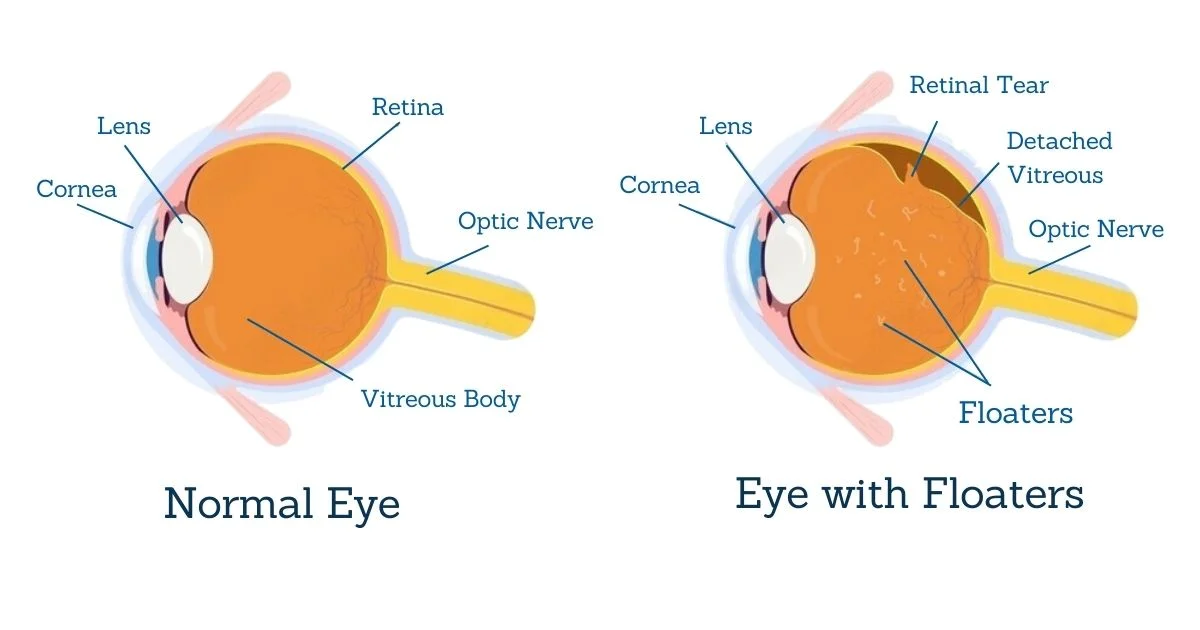
What Are Eye Floaters?
Floaters are tiny specks or threads that float around in your vision, especially noticeable when you're looking at something bright, like a clear sky or a white wall. These aren't actually objects in front of your eye — they're shadows cast by clumps of protein floating inside the vitreous, the jelly-like substance that fills your eye.
Eye floaters become more common as we age. They don't normally go away completely, but they don't usually need treatment. Over time, your brain adapts, and you stop noticing them as much.
At What Age Do Eye Floaters Usually Appear?
For the majority of people, eye floaters begin to appear between the ages of 50 and 70. That said, you might notice a few floaters earlier or later — and if you have high minus glasses power or high myopia, floaters can show up sooner.
If you're under 50 and notice constant floaters, talk to your eye care professional. It could be an indication of an eye condition that needs closer attention.
What Is Posterior Vitreous Detachment (PVD)?
PVD is the medical term for the process behind most age-related floaters. As you age, the vitreous gradually becomes more watery and pulls slightly away from the retina — a completely normal change. As this happens, clumps of collagen fibres form within the vitreous and cast tiny shadows on the retina, which you see as floaters. Many people notice a handful of new floaters over days to weeks as PVD settles, and then things stabilise.
One specific, common type of floater from PVD is called a Weiss ring — a ring-shaped floater that forms when the vitreous fully detaches from around the optic nerve. It's one of the most frequently noticed floater shapes, and if it remains persistent and bothersome, it can sometimes be a good candidate for laser treatment.
What Creates Floaters in the Eye?
Getting Older (PVD)
As explained above, the vitreous gradually degenerates and clumps, casting shadows — the most common cause by far.
Eye Injuries
If something hits your eye, it can release tiny particles into the vitreous that create these specks.
Eye Infections or Inflammation (Uveitis)
When your eye gets infected or inflamed, it can release cells and debris into the vitreous, causing floaters — often alongside light sensitivity or redness.
Problems with the Retina
Retinal tears can happen when the vitreous tugs on the retina with enough force to tear it — this needs prompt treatment.
Diabetes
Diabetic retinopathy can cause bleeding into the vitreous (vitreous haemorrhage), which appears as dark, cobweb-like floaters.
Nearsightedness
If you have trouble seeing things far away (high myopia), you're more likely to notice floaters, and often at a younger age.
Migraines
Some people see floater-like spots or visual disturbances as part of a migraine with aura.
Post-Surgical or Post-Laser Effects
New floaters can appear after cataract surgery or a YAG laser capsulotomy as the eye settles — these usually fade over time.
Most floaters are safe and common, but rapid, dramatic changes or a sudden burst of new floaters can indicate a more significant eye condition.
What Are the Risk Factors for Eye Floaters?
Age over 50 — the single biggest factor, as PVD becomes increasingly likely.
Nearsightedness (high myopia) — a longer eyeball shape raises the likelihood of earlier floaters.
Eye injury — trauma to the eye can trigger new floaters at any age.
Complications from cataract surgery — can occasionally lead to new floaters afterward.
Diabetic retinopathy — damage to retinal blood vessels raises the risk of bleeding-related floaters.
Eye inflammation — chronic uveitis or other inflammatory eye conditions increase floater risk.
What Do Eye Floaters Look Like?
They move when you move your eyes, and seem to dart away when you try to look at them directly — most noticeable against a plain, bright background like a clear sky or a white wall.
When Should You See an Eye Specialist?
You should consult an eye specialist if:
- You notice an increase in the size or number of floaters visible in your vision
- You see flashes of light in your vision, particularly if they're coupled with new floaters
- You observe changes to your visual perception — blurred vision, a gray curtain, or darker peripheral vision, alongside floaters
- You've had a history of eye issues or other conditions that make you more susceptible to eye problems
- Your symptoms persist or get worse over time, regardless of home comfort measures
How Are Eye Floaters Diagnosed?
Eye floaters are diagnosed through a comprehensive eye examination by an eye specialist. During the check-up, the doctor will ask about your symptoms and medical history and perform tests to evaluate the health of your eyes:
Visual acuity test: Assesses your ability to see details at various distances and helps identify any related vision problems.
Dilation: Your pupils are dilated with drops for a better view of your retina and the vitreous, confirming whether the floaters are simply age-related or point to something needing treatment.
Can Eye Floaters Be Prevented?
No, eye floaters cannot be prevented. They are a natural part of the ageing process and occur as the gel-like substance in the eye changes consistency over time. What you can do is get regular eye exams so any concerning changes are caught early.
How Can You Manage Floaters Day to Day?
Use steady, soft lighting
Avoid staring at bright, blank backgrounds for long stretches, which makes floaters more noticeable.
Take screen breaks
Follow the 20-20-20 rule — every 20 minutes, look at something 20 feet away for 20 seconds.
Wear sunglasses outdoors
Reduces glare and contrast that can make floaters stand out more.
Stay hydrated and sleep well
General eye comfort improves with good daily routines.
Eat a balanced, antioxidant-rich diet
Leafy greens and colourful vegetables support overall eye health, though they won't dissolve existing floaters.
Limit heavy caffeine and avoid eye rubbing
Both can increase your awareness of floaters and general eye irritation.
What Are the Medical Treatment Options for Eye Floaters?
Observation
If the situation isn't severe and isn't hurting your vision, your doctor may recommend simply monitoring them. Floaters often reduce with time, or your eyes adapt and learn to ignore them.
Laser Vitreolysis
A focused laser breaks up a large, stable floater — most helpful for a distinct Weiss ring — into smaller, less noticeable pieces. Works best when the floater has been stable for months and sits well away from the lens and retina. It may reduce but not fully eliminate symptoms, and not everyone is a suitable candidate.
Vitrectomy Surgery
A vitrectomy may be recommended in severe cases. The doctor removes the vitreous gel and replaces it with a clear solution, which can minimise or remove floaters. Surgery may not remove every floater, and new ones can occasionally develop afterward.
Fixing Underlying Causes
Treating an underlying eye problem — such as a retinal tear or detachment causing the flashes and floaters — is crucial. This may involve barrage laser treatment or other procedures as needed.
What Are the Risks of Vitrectomy and Laser Vitreolysis?
Both procedures are effective for the right patient, but neither is without risk — this is exactly why they're reserved for persistent, carefully selected cases rather than used routinely.
Temporary Inflammation (Laser Vitreolysis)
CommonMild, short-lived inflammation is a normal part of healing after the procedure.
Increased Floaters (Laser Vitreolysis)
MildSome patients notice temporarily more floaters before things settle.
Faster Cataract Development (Vitrectomy)
CommonIn patients who haven't yet had cataract surgery, vitrectomy tends to speed up cataract formation.
Pressure Spikes (Laser Vitreolysis)
RareUncommon, but eye pressure is monitored closely after treatment.
Infection, Bleeding or Retinal Tears (Vitrectomy)
RareStandard surgical risks of any intraocular procedure, closely monitored during recovery.
Preparing for your appointment: Before you see your eye specialist, it helps to note down:
- Your symptoms, including what makes floaters more or less noticeable
- All medications, vitamins and supplements you currently take
- Any questions you want to ask — such as why you're seeing these floaters, whether they'll always be there, and whether you need a follow-up appointment

Dr. Rajeev JainDirector · Retina, Cataract, LASIK & Uvea Specialist
"The vast majority of floaters patients bring up are simply age-related PVD, and I reassure people that their brain really will adapt over time. But I always ask specifically about how the floaters started — a gradual handful over a few weeks is very different from a sudden shower, especially with flashes of light. That distinction is what tells us whether we're dealing with something completely routine or something that needs same-day attention."
Frequently Asked Questions About Eye Floaters
There is no natural treatment that removes floaters. However, it is advised to drink more water, add antioxidants to your diet, and get good sleep. This can help improve overall eye comfort, though it won't dissolve existing floaters.
Observation is the standard first approach, since most floaters settle or become less noticeable over time. For persistent, intrusive floaters, laser vitreolysis or vitrectomy surgery may be considered after a specialist evaluation.
The main cause is posterior vitreous detachment (PVD) — as we age, the vitreous humour (the gel-like substance filling the eye) gradually liquefies and pulls away from the retina, and the resulting clumps cast shadows that appear as floaters.
Only a few patients continue to notice floaters long-term. For most people, floaters settle or become far less noticeable over time, as your brain adapts and effectively learns to ignore them.
Eye floaters are usually harmless. However, in certain cases they could indicate more serious conditions like a retinal tear that require immediate treatment. Left untreated, a retinal tear can lead to retinal detachment.
Eye floaters may appear as grey or black dots, blobs, lines, cobwebs, strands or rings floating about your field of vision, most visible when looking at a bright, plain background like a clear sky or a white wall.
Eye floaters can happen in one eye or both eyes at the same time. A sudden shower of new floaters in just one eye deserves prompt attention, since it's more likely to signal a retinal problem.
No, generally they are not an emergency. However, regular check-ups and prompt evaluation of any sudden change can prevent severe retinal complications from being missed.
Floaters can appear at any age, but they become far more common after about age 50, as posterior vitreous detachment becomes more likely. People with high myopia may notice them earlier.
No, there's no direct link between floaters and a lack of vitamin D. Floaters are caused by age-related changes in the vitreous, injury, inflammation, bleeding, or retinal problems.
PVD is the medical term for the normal, age-related process where the vitreous gel gradually liquefies and separates from the retina. It's the most common cause of floaters, typically starting around age 50, and floaters from PVD usually appear gradually over days to weeks before settling.
A Weiss ring is a specific, ring-shaped floater that forms when the vitreous fully detaches from around the optic nerve during PVD. It's one of the most common floater types people notice, and can sometimes be a good candidate for laser vitreolysis if it remains persistent.
Laser vitreolysis can break up large, stable floaters — such as a Weiss ring — into smaller, less noticeable pieces. It works best when the floater has been stable for months and sits well away from the lens and retina. It may reduce symptoms but doesn't guarantee they disappear completely, and not everyone is a suitable candidate.
A sudden shower of new floaters, especially combined with flashes of light or a dark curtain across your vision, can be an early sign of a retinal tear or detachment. This needs same-day evaluation, since prompt treatment can prevent permanent vision loss.
Noticed a Sudden Change in Your Floaters?
Get a dilated retinal evaluation at Save Sight Centre, Adarsh Nagar, North Delhi. NABH & ISO accredited · 25+ years · 1,70,000+ patients treated.
Disclaimer: For general awareness only, not medical advice. Please consult an eye specialist at Save Sight Centre to determine the best treatment for your eyes. Results vary by person. Figures cited are approximate and based on general clinical patterns and published research.