
 +91-7873-222-000
 WhatsApp

 Book Appointment
Eye Donation in India: Process, Facts & Myths
Somewhere in India right now, a person is waiting — sometimes for years — for a cornea that could give them their sight back. The gift that could change their life doesn't cost you anything, doesn't require you to be alive to give it, and takes less time than it took you to open this page. Here's everything worth knowing before you decide.

Quick Answer
Eye donation is the voluntary act of giving your eyes after death so the cornea — the eye's clear front layer — can be transplanted to restore sight for someone with corneal blindness. Almost anyone can pledge, regardless of age, eyesight, or most health conditions; wearing glasses, having had cataract surgery, or even LASIK doesn't disqualify you. The process is free, doesn't disfigure the body, doesn't delay funeral arrangements, and takes about 10-20 minutes once a family informs the nearest eye bank within 6-8 hours of death. India needs roughly 150,000 corneal transplants a year against a severe donor shortage — pledging your eyes, and more importantly, telling your family about it, is one of the simplest and most meaningful things you can do.
Key Takeaways
- Only the cornea is retrieved — the eye's appearance is fully preserved with a prosthetic shell, and there is no disfigurement.
- Glasses, cataract surgery, and even LASIK do not disqualify you from donating; eligibility depends on corneal health, not your medical history overall.
- One donor's eyes can now help up to ten people through modern component corneal surgery.
- Family consent is required even if you've pledged — telling your family is just as important as the pledge itself.
- No major world religion opposes eye donation; several explicitly regard it as an act of great virtue.
- India has around 6.8 million people with corneal blindness, most of it fully reversible with a donated cornea.
Figures reflect published estimates from Indian ophthalmic and public health sources.
What Is Eye Donation, Exactly?
Eye donation is the voluntary act of giving your eyes after death to help restore the sight of someone living with corneal blindness. Corneal transplantation — the surgery that makes this possible — is considered one of the most successful of all transplant procedures in medicine, with high success rates and decades of refinement. Unlike organ donation for hearts, kidneys, or livers, eye donation carries no medical risk to the donor for the simple reason that it only ever happens after death, and it asks nothing of you in life beyond a decision and a conversation with your family.
Which Part of the Eye Is Actually Donated?
The cornea — the clear, dome-shaped front layer of the eye that focuses light — is the primary structure retrieved and used for transplant. The rest of the eye is not typically transplanted. Corneas found not medically suitable for direct transplant aren't wasted, either: they're often used for research and surgical training, work that has genuinely helped advance safer techniques in corneal and refractive surgery over the years.
How Big Is the Problem of Corneal Blindness in India?
India carries one of the largest burdens of corneal blindness anywhere in the world. An estimated 6.8 million people in India live with corneal blindness, and around 1 million of them are blind in both eyes — a form of blindness that is potentially fully reversible with a corneal transplant, if a donor cornea becomes available. To clear the existing backlog of patients and keep up with new cases each year, India needs roughly 150,000 corneal transplants annually. The gap between that need and the number of eyes actually donated is exactly what makes every single pledge, and every family's willingness to honour one, genuinely consequential.
Who Can Donate Their Eyes?
Almost anyone can pledge to donate their eyes. Eligibility comes down to the health of the cornea at the time of death, not your age, gender, blood group, religion, or general medical history. In practice, this means:
- People of all ages and genders can donate
- Wearing glasses or contact lenses for any refractive error is not a barrier
- Prior cataract surgery does not disqualify you
- People with diabetes, hypertension, or asthma can typically still donate
- Death at home or in a hospital both allow for donation, provided the eye bank is informed quickly
Who Cannot Donate Their Eyes?
A small number of conditions make corneas unsuitable for transplant, for the safety of the recipient. Eyes generally cannot be donated by people who had:
- Infectious diseases such as HIV/AIDS, hepatitis B or C, rabies, or septicemia
- Acute leukemia, tetanus, cholera, meningitis, or encephalitis
- Death by drowning
- Severe eye diseases such as advanced glaucoma, extensive corneal damage, or serious retinal disorders
In these situations, the donor's family is informed clearly and the decision not to proceed is made with their full understanding — eyes are never retrieved without the family being aware of why.
Can Someone Who Wears Glasses, Had Cataract Surgery, or LASIK Still Donate?
Yes to all three, and this is one of the most common misconceptions people have. Short-sightedness, long-sightedness, astigmatism, and a history of cataract surgery are not barriers to eye donation at all. Even corneas from eyes that have previously had LASIK surgery can still be used — they're often especially well-suited to newer component surgery techniques like DLEK (Deep Lamellar Endothelial Keratoplasty), which uses only specific healthy layers of the donated cornea to treat conditions like corneal swelling after cataract surgery or Fuchs dystrophy. In short: if you've ever assumed your eyes "wouldn't be good enough" to donate because you wear glasses or had eye surgery, that assumption is almost certainly wrong.
How Many People Can One Donor's Eyes Actually Help?
Traditionally, a single donor's pair of eyes could restore sight to two people, one cornea per recipient. With the advent of component corneal surgery — where individual layers of a single cornea are used to treat different specific conditions in different patients — one donated eye alone can now help as many as five people. That means a single person's decision to donate can potentially give the gift of sight to up to ten people from one pledge. Very few personal decisions carry that kind of multiplied impact.
What Should Family Do Immediately After Death to Preserve the Eyes?
If you're the one entrusted with this responsibility, time matters — corneas can only be retrieved within about 6 to 8 hours after death. These simple steps genuinely help preserve them:
- Gently close the eyes and place a piece of moist cotton over them
- Raise the head slightly, about six inches, using a pillow
- Switch off any fans near the body, to prevent the eyes from drying out
- If acceptable to the family and it's warm weather, a plastic bag with a few ice cubes can be placed on the forehead
- If available, antibiotic eye drops can be instilled periodically to reduce infection risk and drying
- Call the nearest eye bank as soon as possible, once the family has given consent
What Happens During the Eye Donation Procedure?
Once informed, a trained team from the eye bank — typically including a doctor and a grief counsellor — travels to the home or hospital where the deceased is. They speak with the family respectfully, take proper written consent, and ask a few questions about medical and family history. The corneas are then retrieved under sterile, private conditions, and the entire process usually takes about 10 to 20 minutes from start to finish. No special room is needed, and the area is restored to how it was found within minutes. The team is acutely aware of the family's grief throughout and works with care to avoid any delay to funeral arrangements. Afterward, a prosthetic shell is placed in each eye socket before the eyelids are gently closed, so the person's appearance remains completely unchanged. The identities of both donor and recipient remain confidential throughout.
How Do I Pledge My Eyes?
Pledging is simple: register with any recognised eye bank, either in person at a hospital or eye bank, or online through the Eye Bank Association of India's donor registration portal. But the single most important step comes right after signing up — tell your family. Since your next of kin will need to contact the eye bank and give consent after your death, a pledge that your family doesn't know about is far less likely to be honoured in the moment. In India, the number 1919 is a toll-free helpline, available 24/7 across the country, for information about eye banks and to report a donation.
What Do Major Religions Say About Eye Donation?
Religious hesitation is one of the most common reasons people avoid pledging — and it's worth knowing that no major world religion actually condemns the act:
Hinduism
Hindu texts describe donating one's own body as among the most worthwhile forms of giving, and selfless giving (daan) is considered one of the most important virtuous acts a person can perform.
Islam
Most Islamic scholars support organ donation after death to save a life, drawing on the Quran's teaching that saving one life is akin to saving all of humanity, while emphasising that the body must not be defiled in the process — which eye donation does not do.
Christianity
The central command to love one's neighbour, echoed across the New Testament, is widely understood by Christian leaders to support organ and eye donation as an act of care for others.
Buddhism & Jainism
Both traditions place deep value on compassion and charitable giving, with donating one's own body for another's benefit regarded as a significant virtue.
Sikhism
Sikh philosophy strongly emphasises selfless service and putting others before oneself, with saving a human life considered among the greatest acts of virtue a person can perform.
What Are the Most Common Myths About Eye Donation?
Donating my eyes will disfigure my face, leaving visible holes in the eye sockets.
A plastic prosthetic shell is placed in each socket before the eyelids are closed, so the person's appearance is completely unaffected.
If I pledge my eyes, doctors won't try as hard to save me if I'm critically ill.
Every doctor is bound by professional oath to save lives, full stop. A pledge to donate after death has no bearing whatsoever on the care you receive while alive.
Donating my eyes in this life means I'll be born blind in my next life.
This belief has no basis in any religious text or logic. If anything, giving someone else the gift of sight is widely regarded as a deeply virtuous act, not one carrying negative consequences.
My donated eyes could be sold on some kind of black market.
Eye donation is entirely voluntary and free. Buying or selling human organs, including eyes, is illegal under India's Transplantation of Human Organs Act, 1994, and eye banks must follow strict, transparent, and equitable allocation rules.
Once I've pledged, no further consent is needed after I die.
Your next of kin still needs to give consent and inform the eye bank after your death for the donation to proceed — which is exactly why discussing your decision with your family matters as much as the pledge itself.
Corneal transplant is an experimental procedure with poor success rates.
Corneal transplant is a routine, well-established procedure performed worldwide for decades, with among the highest success rates of any transplant surgery.
Is Eye Donation Free, or Does It Cost Anything?
Eye donation is completely free for the donor's family — there is no charge for retrieval, preservation, or the transplant process itself. Selling or buying human eyes or corneas is illegal under the Transplantation of Human Organs Act, 1994. Any administrative or transportation costs involved in eye banking are borne by the eye bank or hospital handling the process, never the donor's family.
How Does Save Sight Centre Support Eye Donation?
Save Sight Centre encourages every patient and family to consider pledging their eyes, and can guide you through registering with a recognised eye bank. Restoring sight through corneal transplantation is one of the most meaningful outcomes in all of ophthalmology, made possible entirely by the generosity of donors and the families who honour their wishes.
Save Sight Centre is NABH and ISO accredited and has treated over 1,70,000 patients across cataract, LASIK, retina, and glaucoma care in North Delhi.
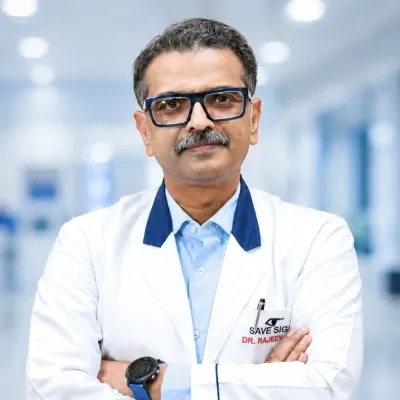
Dr. Rajeev JainDirector · Retina, Cataract, LASIK & Uvea Specialist
"In all my years treating corneal blindness, the single biggest barrier I've seen isn't willingness — it's that people never actually tell their families. A pledge sitting quietly in a drawer somewhere doesn't help anyone if your family doesn't know to call the eye bank. If you take one thing from this article, let it be this: have the conversation. It takes five minutes and it might be the reason someone sees again."
Frequently Asked Questions About Eye Donation
Eye donation is the voluntary act of giving your eyes after death so the cornea — the clear front layer of the eye — can be transplanted into someone with corneal blindness, restoring their sight. It's one of the most successful forms of tissue transplant in medicine.
The cornea, the transparent, dome-shaped front layer of the eye, is the primary part retrieved and used for transplant. The rest of the eye is not typically transplanted, though eyes not medically suitable for transplant may be used for research and training, which also has real value in advancing treatment for corneal disease.
Almost anyone can pledge to donate their eyes, regardless of age, gender, blood group, or religion. Wearing glasses or contact lenses, having had cataract surgery, or even LASIK does not disqualify you. People with diabetes, hypertension, or asthma can typically still donate, since eligibility depends on the health of the cornea at the time of death, not overall health history.
People who died of or had infectious diseases such as HIV/AIDS, hepatitis B or C, rabies, septicemia, acute leukemia, tetanus, cholera, meningitis, or encephalitis cannot donate. Death by drowning is also generally excluded. Severe eye diseases like advanced glaucoma, extensive corneal damage, or certain retinal disorders can also make corneas unsuitable, since these conditions may compromise corneal quality.
Yes to all three. Short-sightedness, long-sightedness, astigmatism, and prior cataract surgery are not barriers to eye donation. Corneas from eyes that have had LASIK can still be used, particularly for newer component surgery techniques like DLEK (Deep Lamellar Endothelial Keratoplasty), which treats conditions like corneal swelling after cataract surgery or Fuchs dystrophy using only specific layers of the donated cornea.
Traditionally, one donor's pair of eyes could restore sight to two people. With modern component corneal surgery — where individual layers of a single cornea are used for different specific conditions — one donated eye can now help up to five patients, meaning a single donor's pledge can potentially benefit as many as ten people.
India carries one of the world's largest burdens of corneal blindness, with an estimated 6.8 million people affected, of whom around 1 million are blind in both eyes — a form of blindness that is potentially fully reversible with a corneal transplant. To clear the existing backlog and keep pace with new cases, India needs to perform roughly 150,000 corneal transplants every year, a target that depends entirely on voluntary eye donation.
Gently close the eyes and place a piece of moist cotton over them. Raise the head slightly, about six inches, with a pillow. Switch off any fans near the body to prevent the eyes from drying out. If possible and acceptable to the family, a plastic bag with a few ice cubes can be placed on the forehead, especially in warm weather. Most importantly, call the nearest eye bank immediately — corneas can only be retrieved within about 6 to 8 hours after death.
A trained team from the eye bank, usually including a doctor and a grief counsellor, visits the home or hospital after being informed of the death. They take proper written consent from the family, then retrieve the corneas under sterile conditions in a private setting. The entire process typically takes about 10 to 20 minutes, does not require a special room, and does not delay funeral arrangements in any way.
No. After the corneas are retrieved, the eye doctor places a plastic prosthetic shell in the eye socket before gently closing the eyelids, so the appearance of the deceased is completely unaffected. This is one of the most persistent myths about eye donation, and it simply isn't true.
You can register with any recognised eye bank, either in person or online through the Eye Bank Association of India's donor registration portal. After registering, the single most important step is telling your family about your decision, since they will need to inform the eye bank after your death for the donation to actually happen. In India, you can also call 1919, a toll-free number available across the country, for information or to report a donation.
Yes. Even with a signed pledge, your next of kin must give consent and inform the eye bank after your death for the donation to proceed. This is exactly why discussing your decision with your family while you're alive is just as important as the pledge itself.
No major religion condemns eye donation. Hindu texts describe donating one's body as among the most worthwhile acts of giving. Islamic teaching, drawing on the Quran's statement that saving one life is like saving all humanity, generally supports organ donation after death. Christian teaching's central command to love one's neighbour is widely interpreted to support donation. Buddhism and Jainism place high value on compassion and selfless giving. Sikh philosophy emphasises giving and service to others above oneself. Across faiths, eye donation is consistently viewed as an act of charity, not a violation of religious principle.
This is a myth with no basis in religious texts or logic. If anything, most faiths regard the selfless gift of sight to another person as a deeply virtuous act, not one carrying any negative consequence. This belief has discouraged many potential donors despite having no actual grounding in the religions it's sometimes attributed to.
Eye donation is completely free for the donor's family. There is no charge for the retrieval, preservation, or transplantation process, and selling or buying human eyes or corneas is illegal under India's Transplantation of Human Organs Act, 1994. Any costs involved in eye banking are covered by the eye bank or hospital, not the donor's family.
Give the Gift of Sight — Pledge Your Eyes Today
Talk to the team at Save Sight Centre, Adarsh Nagar, North Delhi, about pledging your eyes, or simply have the conversation with your family this week. NABH & ISO accredited · 15+ years · 1,70,000+ patients treated.
Disclaimer: This article is for general educational purposes. For registration, eligibility confirmation, and formal pledging procedures, please contact a recognised eye bank or the Eye Bank Association of India directly.